There are some excellent animation principles at play in this short film. Appealing spacing and arcs and sheep.
The link was emailed in by Michelle Boland (animation culture writer) via the Spungella blog.
Showing posts with label animation principles. Show all posts
Showing posts with label animation principles. Show all posts
Sunday, September 4, 2011

Saturday, June 18, 2011
Be Quiet - Henry Zhang
This is a first year animation from UCLA Animation Workshop. Look for the arcs and spacing. If you smile, that's because of the timing.
Monday, June 13, 2011
Animation Type - Straight Ahead Animation for FX
Michel Gagné is an animator who creates wonderful animated FX. Using a 2D style, Gagné has worked with Brad Bird on "Iron Giant" and "Ratatouille". It is worth researching his 2D effects channel on YouTube and then having a go at animating some of the FX.
Animated effects are often organically formed in the animator's imagination with a bit of planning but 'feeling' the animation by working straight ahead. Jason Lynch, our special guest stop motion feature film animator, spoke about this animation type and the animation principles in his recent workshop with SBIT animation students.
The other recently featured FX animator on this blog is Ryan Woodward.
Animated effects are often organically formed in the animator's imagination with a bit of planning but 'feeling' the animation by working straight ahead. Jason Lynch, our special guest stop motion feature film animator, spoke about this animation type and the animation principles in his recent workshop with SBIT animation students.
The other recently featured FX animator on this blog is Ryan Woodward.
Wednesday, May 11, 2011
Thought of You - Ryan Woodward
Some new work by Ryan Woodward and any excuse to bring this animation to the top of the post pile. There also is a final version of the documentary "Making of ...Thought of You" to explore.
I posted about Ryan Woodward's work in May 2010 (below)
Once through for entertainment. Oh, OK, twice through for entertainment because the first viewing is quite stunning. Then study this animated music clip. Note the animation principles. Do you think he used video reference? Note the hand drawn appeal. Ryan Woodward is making a making of documentary. Find out more here.
Google - Martha Graham from Ryan J Woodward on Vimeo.
I posted about Ryan Woodward's work in May 2010 (below)
Once through for entertainment. Oh, OK, twice through for entertainment because the first viewing is quite stunning. Then study this animated music clip. Note the animation principles. Do you think he used video reference? Note the hand drawn appeal. Ryan Woodward is making a making of documentary. Find out more here.
Friday, April 29, 2011
Pocoyo - Dance Off!
I love the animation appeal in Pocoyo. It is pose-to-pose animation at its best. Worth studying for timing and learning how long to hold a key pose. When Pocoyo is mixed with dance the benefit for animation students is doubled. Dance is another great visual teacher on music tempo and animation timing. Have you ever seen a dancer as good as Pato? Pocoyo's surfers' stomp (twist) is gold.
How much animation can be produced in 90 minutes?
Dailymation is a blog by Yoni Goodman who was director of animation on the film "Waltz with Bashir".
Found this blog via Cassie V's Sketchbook Thoughts blog.
Tuesday, April 12, 2011
Animator's Hands and The Moment of Contact
The second years have been riding along with my explorations on the theme of the "Moment of Contact".
We watched the meeting sequence in How To Train Your Dragon, where Hiccup makes contact with Toothless - the anticipation was about 7 minutes.
We watched Summer Wars and a different type of contact, this time between two human characters. An initial little finger touch building through at least two more powerful hand holds as the emotion in the story intensified.
Something to realise as an animator is that the sense of touch in humans, a life-form the viewer strongly empathises with, is expressed most strongly through the hands. When people describe something as "touching", they describe the idea that contact was made with their emotions.
Hands are important in communication and animation. In many cases they can be regarded as 'best supporting actors' or 'betrayers of emotion'. The secondary action (an animation principle) portrayed in the hands can be at counterpoint to how the character is acting, but at the same time a revelation of how the character is truly thinking or feeling.
Studying people's hands, the shapes, the gestures, the tension, the floppiness during any communication exchange can reveal so much about the true feeling of a moment and the energy and emotion of the speaker.
Milt Kahl's hand drawings are often referenced as examples (especially search out the ruff versions).

Below is a show reel by Mike Stern who animated on How To Train Your Dragon. Watch, in particular, the hand acting at about 00:36 onward. The acting, the contact, may communicate more in that sequence than the dialogue?
Wednesday, March 16, 2011
Monday, February 21, 2011
Pixar - Animated Logo - Animato
Second year animators are working on the "Animato" project in their Create 3D Digital Animation subject.
The "Animato" project is where the animators form the word 'Animation' from letters modelled by 7 different studio teams for the Create 3D Digital Environments subject.
It will be a 5 to 15 second animated clip that can be used as a base design for an animated logo to attach to their animated work.
Some animators are struggling to find their animated logo. The minimum requirement is a bouncing ball and being able to clearly see the word "Animation".
The Pixar Studios animated logo lasts 13 seconds, has a bouncing character, displaying the animation principles, interacting with the letters in the environment. It should serve well as inspiration.
The "Animato" project is where the animators form the word 'Animation' from letters modelled by 7 different studio teams for the Create 3D Digital Environments subject.
It will be a 5 to 15 second animated clip that can be used as a base design for an animated logo to attach to their animated work.
Some animators are struggling to find their animated logo. The minimum requirement is a bouncing ball and being able to clearly see the word "Animation".
The Pixar Studios animated logo lasts 13 seconds, has a bouncing character, displaying the animation principles, interacting with the letters in the environment. It should serve well as inspiration.
Saturday, October 23, 2010
Running Out of Time? Animate the Eyes
 The second years are in the final weeks of animation production. Actually they should be in animation post production now. But there is always time for a bit more polish and then a re-render.
At the start of semester the class spent some time looking at eye animation as part of facial animation. We studied blinks and eye darts in relation to a character appearing alive and thinking. We discussed the importance of eye shapes and eye brow shapes as recognisable forms of expression.
Importantly we discussed that audiences look at the eyes of our characters. They look for subtext in the eye animation, emotional triggers in the eye and eyebrow shapes. Audiences look to where characters look, which is important for the animation principle of staging (yes, I had to sneak an animation principle in there).
There is a post over on Pete Emslie's The Cartoon Cave blog that talks about eye direction. It also links to John K's blog post about character design, if anyone is into exploring. I found it via Alonso's Monotreme Dreams blog.
Pete writes, As it happens, I've just lectured about the design and function in drawing eyes as part of my Character Design class at Sheridan this past week, so I'd like to offer my thoughts on that subject in regard to this particular still from the Disney film...

But all that is just 'lkhqgfwqrfgygyiggcgfgkvsd' during the CRUNCH!
Hopefully there is a little voice in the animator's zombified brains tweeting, "Running out of time? Animate the eyes!"
Sunday, September 12, 2010
Simplicity
 The illustrations above are by Bryan Ballinger. Bryan has a university degree in illustration. He is also a professor of Digital Media Arts at Huntington University in Indiana USA. So the intro should actually read as Prof. Bryan Ballinger. Why is he drawing like that and what has it got to do with animation?
The more we study animation the more we understand that it takes a lot of work to make simplicity look good. Or does it?
It might just be a matter of practice. Well, yes, it is a matter of practice. A simple practise based in fun and free sketching. Simplicity, like animation, is learnt in the doing. Sometimes burdening a course of study with the term "hard work" too much, too often, sucks the fun out of things.
By setting our ruff feet firmly on a foundation of the 13 principles of animation, an animation student gets the secrets to making a simple character animate with Appeal (well, c'mon, if I'm going to be constantly juggling 13 Animation Principles, eventually I have to drop one... into a blog post).
It might just be a matter of practice. Well, yes, it is a matter of practice. A simple practise based in fun and free sketching. Simplicity, like animation, is learnt in the doing. Sometimes burdening a course of study with the term "hard work" too much, too often, sucks the fun out of things.
By setting our ruff feet firmly on a foundation of the 13 principles of animation, an animation student gets the secrets to making a simple character animate with Appeal (well, c'mon, if I'm going to be constantly juggling 13 Animation Principles, eventually I have to drop one... into a blog post).
The first years just handed in a 2D character animation. A few of them discovered the power of simplicity as an animation tool. The second years are wrestling with their major projects and some are learning that planning for simplicity in design may have allowed a bigger sleep budget in the production schedule.
The end result is that as animators we should get out our simplicity and exercise it.
Here is a blog post entitled "Exercising my Simplicity" on Breadwig that some of the drawing, sketching, illustrating animators may enjoy? (and the self assigned* non-drawers may find a spark of inspiration). Also check out bryanballinger.com .

I found Breadwig via Keith Lango's blog. The simplicity theme is inspired by Simon's Cat, Alexeev's Forest Trio, and Cameron Miyazaki's balls. *I believe everyone can draw.
Thursday, September 2, 2010
Balance and Yellow
Balance in a key pose is important. It is important for the visual communication of believability between the animator and the viewer through the character. Otherwise the viewer will sense that something aint quite right and not find appeal in the animation. Yep, the animation principle of Appeal.
Balance, Line of Action, Psychological Gestures, Meaningful Symbolism all form a part of posing. Posing can be thought of within the animation principle of Solid Drawing. But it also features, by name, in the principle of Animation Type, when talking about Pose-to-Pose animation.
Balance is influenced by gravity. Gravity does not automatically exist on a piece of paper or in animation software. So an animator has to practice with gravity some other way to work out how to show it in animation. One way is to "Act It Out".
The other way is to pose a character who is influenced by gravity. Introducing "Yellow". (I think the pose below is the pose Jess - 2nd Yr - created).

If the computer screen has fraznicked your thinking, spend some refresh time posing "Yellow". He resides inside the digital camera box.
Yellow appears on some second year blogs already: Sarah P (the first one to achieve balance on one leg) and Cassie V.
Workplace health and safety warning notice: 1 leg poses should only be attempted by 2nd years. Do not attempt to act out poses found on these blogs at home without clearance from your physiotherapist.
Balance, Line of Action, Psychological Gestures, Meaningful Symbolism all form a part of posing. Posing can be thought of within the animation principle of Solid Drawing. But it also features, by name, in the principle of Animation Type, when talking about Pose-to-Pose animation.
Balance is influenced by gravity. Gravity does not automatically exist on a piece of paper or in animation software. So an animator has to practice with gravity some other way to work out how to show it in animation. One way is to "Act It Out".
The other way is to pose a character who is influenced by gravity. Introducing "Yellow". (I think the pose below is the pose Jess - 2nd Yr - created).
If the computer screen has fraznicked your thinking, spend some refresh time posing "Yellow". He resides inside the digital camera box.
Yellow appears on some second year blogs already: Sarah P (the first one to achieve balance on one leg) and Cassie V.
Workplace health and safety warning notice: 1 leg poses should only be attempted by 2nd years. Do not attempt to act out poses found on these blogs at home without clearance from your physiotherapist.
Sunday, August 1, 2010
Act It Out - Animation Preproduction Planning
In 2009 I made a post about "Acting It Out"! That post features a video clip of the great Ian Lacey passionately delivering a message to animation students. The message is still relevant (even though we have phones these days that drive your car and make morning coffee).
Actually I have a blog post label over on the side there called "planning". There is also one screaming "Act it Out". There is some interesting information under those links. Just for the 'hey' of it I'll say it again, planning. Hey!
Animators are a good looking bunch of bananas.
Animators act out an animation sequence to get ideas on timing (an animation principle), posing and a variety of acting choices.
But there is another reason why animation students should act it out. Have you ever seen an animator's brain explode? Sometimes it can be messy. Really messy. All that pressure builds up and BOUMPLATHFF! Hopefully just a little puff of steam comes out of the ears and the head bumps noisily on the desk. Sometimes it's a volcanic Vesuvius of ideas vomit. Not pretty. It happens to animators who think that animation is created at a computer.
Acting it out gets the animation out of the brain and into the body. Acting it out gets it out of the migraine and onto video reference tape. It gets it out of the brain where it is a swirling fog and into ruff marks on paper.
Stay pretty. Act it out.
This post is brought to you by the animation student who... 3 weeks into semester, 3 weeks into a new animation project, where we are: working through brainstorming; thumbnailing ideas; storyboarding; acting it out and collecting video reference; ruffing out sketches; recreating, critiquing and improving key, story telling, golden poses... after one of my lectures about animation being created in the planning, while looking longingly at a computer, asked, "Are we going to do some animation today?"
People, we are animating every day. I guess the beauty is that some of us don't realise it.
The clip below is an exercise in finding key poses from Acting It Out and taking video reference. The first years are animating some dialogue of Jack Black from the film "School of Rock". There are some ripper poses in this example. The animators have been AfterEffected to protect their identities from the paparazzi. With a bit of exaggeration (an animation principle), there is potential for some rockin' animation!
The teacher character's dialogue in this clip is anathema to the actual teaching of animation going on in class. It's text! We see through the skin of text to the core of subtext. It's an animator's superpower - animator's eyes! Narrative x-ray vision!
Actually I have a blog post label over on the side there called "planning". There is also one screaming "Act it Out". There is some interesting information under those links. Just for the 'hey' of it I'll say it again, planning. Hey!
Animators are a good looking bunch of bananas.
Animators act out an animation sequence to get ideas on timing (an animation principle), posing and a variety of acting choices.
But there is another reason why animation students should act it out. Have you ever seen an animator's brain explode? Sometimes it can be messy. Really messy. All that pressure builds up and BOUMPLATHFF! Hopefully just a little puff of steam comes out of the ears and the head bumps noisily on the desk. Sometimes it's a volcanic Vesuvius of ideas vomit. Not pretty. It happens to animators who think that animation is created at a computer.
Acting it out gets the animation out of the brain and into the body. Acting it out gets it out of the migraine and onto video reference tape. It gets it out of the brain where it is a swirling fog and into ruff marks on paper.
Stay pretty. Act it out.
This post is brought to you by the animation student who... 3 weeks into semester, 3 weeks into a new animation project, where we are: working through brainstorming; thumbnailing ideas; storyboarding; acting it out and collecting video reference; ruffing out sketches; recreating, critiquing and improving key, story telling, golden poses... after one of my lectures about animation being created in the planning, while looking longingly at a computer, asked, "Are we going to do some animation today?"
People, we are animating every day. I guess the beauty is that some of us don't realise it.
The clip below is an exercise in finding key poses from Acting It Out and taking video reference. The first years are animating some dialogue of Jack Black from the film "School of Rock". There are some ripper poses in this example. The animators have been AfterEffected to protect their identities from the paparazzi. With a bit of exaggeration (an animation principle), there is potential for some rockin' animation!
The teacher character's dialogue in this clip is anathema to the actual teaching of animation going on in class. It's text! We see through the skin of text to the core of subtext. It's an animator's superpower - animator's eyes! Narrative x-ray vision!
Thursday, July 8, 2010
Small Bird Flying Cycle - Don Bluth
I like this clip because Don talks about the animation principle of "Slow-In and Slow-Out", or as we may say in the studio, "Ease-In and Ease Out". He is talking about the spacing of the animation of the wings.
How about trying this 4 drawing cycle (on twos) and test it out with a line test or three?
How about trying this 4 drawing cycle (on twos) and test it out with a line test or three?
Friday, April 9, 2010
There is no penalty for nerdiness
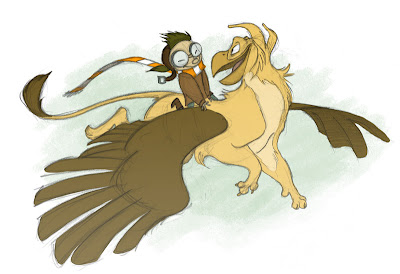
Nerdiness, when examined closely, is akin to crazyness (yes, spelt with a 'y').
Crazyness is a form of curiosity that manifests when an animator experiments with ideas*.
You may have heard me mutter in class, usually in regards to assessment, "There is no penalty for crazyness." It would seem that the same could apply to nerdiness, if either word actually existed in the English language.
Memories of the section in Jennifer Hager's showreel from 2007 ( from about 1:44 to 2:33) were re-kindled while I watched "How to Train Your Dragon". The character interaction and timing in particular were strongly reminiscent. You will note that Jennifer's hero is a girl.
With a bit more research I find she is animating at Disney. Again, great timing; to pursue traditional 2D animation skills as a student and then land a job when Disney needed 2D animators.
Animation is in the timing, Chuck Jones was correct.
It may be pleasing to note, by looking at Jennifer's blog, that she is a self-professed animation nerd (check out her cats' names).
The full "Sky Bound" student film can be seen here (as well as many other CalArts student work).
*That does not mean misunderstanding animation principles. Students have to demonstrate they understand and can apply the animation principles. In saying that, pursuing proper animation delivery should not be a constraint to an animator's imagination. And, hopefully, somewhere in the animation testing things were taken too far before returning to required perfection.
Wednesday, March 3, 2010
Arcs
 Ok Go use a technique in the linked music video (embedding is disabled) that captures frames to a green screen behind the characters. I found the original discussion on how it relates to animation in the 11 Second Club forum in a thread by Eric Scheur.
Eric writes, "This one, for the song "WTF?" was done in front of a green screen, so that each successive frame could be applied to the background as the new one was captured. It has a cool look, of course (and I love those striped sticks wiping the screen!), but it also made me think "Wow! This is like an animation tutorial about arcs!" If you've ever taken your arcs for granted, figuring that they don't need polishing "because things are kind of hurky jerky in real life, after all," this video makes a compelling case for even the hurky-jerky movements happening in pretty sweet arcs."
Arcs are an animation principle that should be applied to your animation.
Sunday, February 21, 2010
Appeal
A quick revision about the animation principle of Appeal:
Appeal in animation can be looked at in 2 basic parts:
1. Design Appeal = the character designs look nice, or 'cool'. The layouts or 3D environment look great. That is one form of visual appeal.
I think of it as looking at an animation movie poster and responding with "Wow, that looks good, I'd like to see that."
2. Motion Appeal = The more important form of appeal in animation (for me) is related to how things move.
For instance, a character design is not appealing (e.g. a character representing a piece of snot). But the way an animator animates that character, can make it move in an appealing, interesting way. I imagine a snot character would be great to animate with lots of stretch and squash, for example.
I really find the animation of Pocoyo appealing, in terms of motion. Some may say the design is simple (I find it appealing), but it is the appeal in the animation that captures my interest: http://www.youtube.com/user/pocoyotv
So if we add Design Appeal + Motion Appeal = VISUAL Appeal; the animation principle of Appeal.
Have you found any other descriptions in your research? Let me know what you find.
Appeal in animation can be looked at in 2 basic parts:
1. Design Appeal = the character designs look nice, or 'cool'. The layouts or 3D environment look great. That is one form of visual appeal.
I think of it as looking at an animation movie poster and responding with "Wow, that looks good, I'd like to see that."
2. Motion Appeal = The more important form of appeal in animation (for me) is related to how things move.
For instance, a character design is not appealing (e.g. a character representing a piece of snot). But the way an animator animates that character, can make it move in an appealing, interesting way. I imagine a snot character would be great to animate with lots of stretch and squash, for example.
I really find the animation of Pocoyo appealing, in terms of motion. Some may say the design is simple (I find it appealing), but it is the appeal in the animation that captures my interest: http://www.youtube.com/user/pocoyotv
So if we add Design Appeal + Motion Appeal = VISUAL Appeal; the animation principle of Appeal.
Have you found any other descriptions in your research? Let me know what you find.
Wednesday, February 3, 2010
Our favourite rascal Sunny Kharbanda ~ Show Reel
Here's a selection of my recent character animation work. copyright 2009 Hardeep Kharbanda.
http://www.sunnykharbanda.com/
I've just been past Sunny Kharbanda's new blog and thought I'd post his show reel for the second years to see. Look! it's only just over a minute long. Note that down. His blog is full of sketches, so that should keep the constant scribblers happy.
I was thinking of how I am currently in animation student mode studying some Jason Ryan webinars where we are animating broad cartoony actions. I wonder if they will influence what I teach?
What I like about Sunny's reel is the cartoony style of animation being explored with a free 3D rig (Moom). There is also some 2D work in there showing off an understanding of animation principles.
According to Sunny's 'About Me' page he is now teaching animation at The Art Institute of Washington.
Have a read of his critique of "Up". And just for Will, here is how he made those old Warner Brothers style backgrounds. Oh, yes, there is a post on how to get that toon render on a 3D model, but you will have to facilitate your own learning for that one and look through the blog.
Tuesday, February 2, 2010
Drawing and Learning Animation
 There is an animation principle called "Solid Drawing". It is an animation principle from the time of Disney's '9 Old Men'. An era before the evolution of 3D animation.
I distinctly remember an interview with one of those famous Disney animators, Milt Kahl, where he comments that animators should be able to draw well. Now, that can be a bit daunting for some animation students and these days may no longer always be the case.
But there is an important point to make here. Even if an animator says they can't draw. That doesn't mean that they are excused from drawing. A personal perception of being unable to draw doesn't mean
 that an animator is excused from trying to improve a skill that can be important in developing their overall animation skills. That would be folly.
The important thing to understand is that everyone can draw. We all draw our own way. An animation course is not a drawing competition. You will see some wonderful illustrators in an animation course. Sometimes being a good illustrator can be a handicap for developing animation skills. An attention to detail can be a tough habit to shake.
!Work Ruff
In the big picture, the majority of drawings an animator produces will never be seen by more than a few people. Those drawings have the primary goal to communicate ideas. The drawings are used as communication in a tribe of craftspeople who communicate visually.
As long as you can draw characters in an economical stick figure style, then you can communicate ideas and plan your animation.
Working rough, or "ruff", is the way most of the drawings are produced when planning an animation. This goes for doodling ideas for a character design, or for thumbnailing* early storyboarding, or for doing 1 minute sketches in life drawing classes. (*thumbnail size sketches)
Staying loose and sketchy captures more than
 the image of what is being drawn. Within loose and sketchy "ruff" line works an animator captures motion. Loose, sketchy line work illustrates forces, movement and 'the illusion of life'.
Drawing for animation is more about communication of movement through abstraction or representation of motion rather than rendering beautifully detailed images.
For the animators who illustrate beautifully already, thankyou, it is awesome to see your work. A due reward for uncountable hours, pages of all types of paper, stacks of sketchbooks, of practice copying favourite characters and evolving an own style.
For skilled illustrators drawing ruff provides excitement in drawing in a way that frees an artist up from the dedication to detail. Working ruff and not becoming emotionally invested in each drawing will help enliven your style when you return to produce a finished artwork.
Even in areas of the craft where drawing skills can be brought out on display, such as storyboarding, the same basic idea of economical drawing as communication can be applied. As Karen J Lloyd describes on her storyboarding blog, "If you’re capable of writing your name, you can draw."
In a recent post on the Animation Mentor Tips and Tricks blog, Aaron Hartline discusses the question, "Do You Need to Have a Drawing Background to Be a 3D Animator?" for animators who seek refuge in software away from the drawing board.
Just as animation has evolved from the era of Disney's 9 Old Men, when the animation principles were hatched by Frank Thomas and Ollie Johnston, so has the animation principle of "solid drawing" evolved. It has spread its intent into new animation forms, such as 3D animation, to embrace such things in as; Posing, Balance, Line of Action, Gestures, Silouhette, Meaningful Symbolism, Feeling of Weight, Implication of Mass and Volume. At the same time it is an animation principle that still retains important traditional, hand-drawn animation aspects such as Staying on Model.
Practicing the skill of drawing will make you a better animator as well as a better illustrator. Two prizes with one effort.
Wednesday, April 29, 2009
Non-verbal communication
It has been stated by scholars who study body language that 60 to 80% of human communication is through non-verbal communication, or body language.
In terms of animation, that adds some meaning as to why some animation communicates so well without dialogue and why we love, for example, French animation, or Japanese animation so much. See the post about Shane Acker's short film "9" (below), as a recent example of animation that communicates without dialogue.
Ian Lacey (Animation Resource Centre) always encourages his students, who seek to be character animators, to animate what the character is thinking.
Acting for Animators author, Ed Hooks, also describes it as essentially important.
The important communication is displayed through the character's body language.
The animation is particularly delicious when the dialogue was in contradiction to how the character was communicating non-verbally. It can drive a whole story in the opposite way to the characters' dialogue thus giving insight or unease to the audience. The animator is the one who controls it.
I think it is important for animation students to realise the importance of recognising non-verbal communication as a skill. Firstly, in terms of observation. Observation being: seeing + thinking about what you are seeing. And secondly in looking to thoughtfully apply techniques, such as: facial touching gestures, psychological gestures, line of action reversals, power centre shifts, meaningful symbolism to every opportunity in animating.
Hey, those things sound familiar don't they? Psychological Gestures, Line of Action, Power Centres, Meaningful Symbolism... they all relate to posing in story telling poses (click for a great resource .mov download from Keith Lango).
Many of you have probably already seen this video on body language (I'm sure Dan might like it for the music ;) ) ...
An interesting experiment for student animators is to search video sharing sites for video reference on body language. You will pick up some good ideas and maybe even someone at a nightclub.
In terms of animation, that adds some meaning as to why some animation communicates so well without dialogue and why we love, for example, French animation, or Japanese animation so much. See the post about Shane Acker's short film "9" (below), as a recent example of animation that communicates without dialogue.

Ian Lacey (Animation Resource Centre) always encourages his students, who seek to be character animators, to animate what the character is thinking.
Acting for Animators author, Ed Hooks, also describes it as essentially important.
The important communication is displayed through the character's body language.
The animation is particularly delicious when the dialogue was in contradiction to how the character was communicating non-verbally. It can drive a whole story in the opposite way to the characters' dialogue thus giving insight or unease to the audience. The animator is the one who controls it.
I think it is important for animation students to realise the importance of recognising non-verbal communication as a skill. Firstly, in terms of observation. Observation being: seeing + thinking about what you are seeing. And secondly in looking to thoughtfully apply techniques, such as: facial touching gestures, psychological gestures, line of action reversals, power centre shifts, meaningful symbolism to every opportunity in animating.
Hey, those things sound familiar don't they? Psychological Gestures, Line of Action, Power Centres, Meaningful Symbolism... they all relate to posing in story telling poses (click for a great resource .mov download from Keith Lango).
Many of you have probably already seen this video on body language (I'm sure Dan might like it for the music ;) ) ...
An interesting experiment for student animators is to search video sharing sites for video reference on body language. You will pick up some good ideas and maybe even someone at a nightclub.
Subscribe to:
Posts (Atom)